|
Financial Professionals Winter 2026
This is my quarterly agglomeration, intended primarily for my fellow financial professionals. It’s simply a way to share things of possible interest that I have read or thought about this quarter. Enjoy!
You may have noticed this email has a little different look. It’s been twenty years now since Anitha and I launched Financial Architects, and while it hasn’t been that long since we refreshed the website and newsletters, it seemed appropriate on this milestone to give it a little attention.
Last quarter I said, “I think this is the longest one ever. Sorry about that, but I hope you get something out of it!” Yet this quarter’s is even longer!
First, last quarter (here) I passed along a tidbit about HSAs that was incorrect. (Thanks to W. Glenn Cooper, a CPA at LP Martin & Co., for the correction.) Anyway, now I’m back to what I have thought for years – you’ve got to spend it before you die (or your spouse does). I thought I was reporting good news, but I was merely creating fake news.
Second, last quarter I shared a chart with median net worth by age (link), this quarter I have median salary by age:
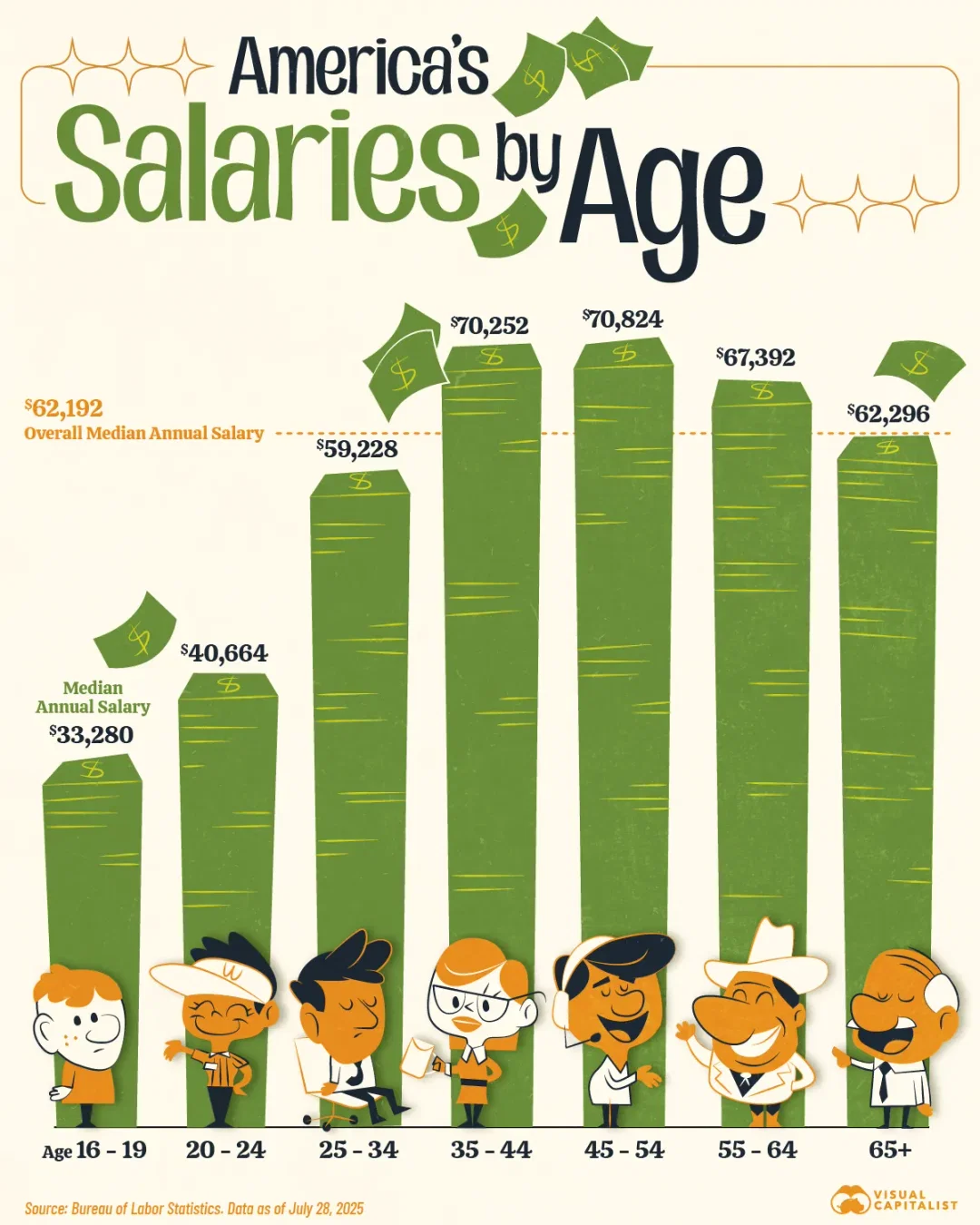
As with the previous chart, I like that it is median and not average. That’s a much better benchmark due to significant positive skewness in the distribution.
Third, Elm Wealth had a nice piece on capital market assumptions (link). Notice that their ERP for U.S. is 1.31% while for international it’s 4.86%. Recall that Stocks for the Long Run claimed a long-term ERP of 6.5% or so (though I, and others, have issues with Siegel’s data and methodology). 1926-2024 inclusive saw geometric mean returns of 10.16% on stocks (CRSP 1-10), 5.03% on bonds (20-year Treasurys), and 2.94% inflation (CPI) – that’s a 5% ERP (would have been a little higher if I used shorter-term bonds, but I don’t have a continuous bond index other than 20-year any more). We should expect a much smaller ERP on U.S. stocks going forward. (U.S. stocks in general, I think the overvaluation is in large growth, so small and value should be fine – well, as fine as stocks ever are.)
Fourth, an interesting observation about private equity (source):
“There are 19,000 private equity funds in the US. There are 14,000 McDonald’s in the US. How are there more private equity funds than McDonald’s? That’s actually crazy, right?” KKR & Co. partner Alisa Wood said Wednesday at Bloomberg’s Women, Money and Power event in London.
And another one about AI (source): “To provide some sense of scale, that means the equivalent of about $1,800 per person in America will be invested this year on A.I.”
See also, Apples and Oranges: Benchmarking Games and the Illusion of Private Equity Outperformance (link).
“The dark joke circling around the industry is that many private-equity firms have already raised their last fund but don’t know it yet.” (source)
Also, see PE volatility laundering here (alternative link).
This is starting to feel like the internet fiber build-out in the 1990s or the railway network build-out in the 19th century. Neither of those ended well for investors.
More echoes of the dot com bubble (source):
According to a report published by Fortune, AI investors are starting to worry about “creative accounting” issues, where companies are signing one-off contracts and then annualizing those numbers as “ARR” so that it seems like they’re making more money than they really are. As one investor told Fortune: “The problem is that so much of this is essentially vibe revenue.”
- Case in point: Andreessen Horowitz–backed AI “cheat on everything” tool Cluely, claimed over the summer to have doubled ARR to $7 million in a week.
In some cases, the accounting is downright fraudulent. 11x, a startup valued at $700 million, reported $14 million in ARR. Turns out that wasn’t true. They were counting canceled contracts in their ARR number — in reality, revenue was closer to $3 million.
Rezolve AI went public via SPAC merger in late 2024 claiming to be an AI company. However, according to former employees, it was all marketing hype: The company had 0 revenue from AI in 2024.
- A research report published last week now alleges that the company’s 2024 revenue came entirely from soccer ticket sales.
AI hype has created a feedback loop where startups stretch ARR, boosting valuations and raising new investor interest and FOMO-based funding. Median late-stage AI startup valuations are already 3x higher than valuations of non-AI companies. No doubt there’s real innovation here, but what happens if the foundation of this new tech cycle rests on circular revenues and “vibe-based” ARR?
Fifth, the story of the decline of the .400 hitter (link) is the same as the decline of the superstar active manager.
Sixth, as shown here, most stocks underperform. This positive skew is why you should index! Factor tilts (in my opinion) are not about finding winners, they are about systematically removing likely losers. You don’t know where the winner will come from, but it’s unlikely to come from the small unprofitable growth stocks so you want to eliminate (or underweight) those and keep everything else.
Said another way, stocks are lottery tickets, albeit with a positive expected return – so you basically want to buy all the tickets (link).
Seventh, good paper on managing concentrated positions here. The authors look at using “completion portfolios” (direct indexing and long-short direct indexing) and conclude (as I have long said) the optimal solution is to sell ASAP!
Of course, the urgency depends on:
- How large the position is relative to the client’s balance sheet (including human capital)?
- How large the gain is as a percentage of the position?
- Their need for the assets – perhaps they would be just fine even if it went to zero?
- Their life expectancy – I’m probably not going to sell immediately if they are in hospice!
The authors do not address these factors nor do they discuss using exchange funds or 351 conversions/exchanges. A CRAT could also be a viable strategy.
I made a list of the strategies grouped by relevant factors:
- If you have charitable intent:
- Sell and donate – sell higher-basis lots while donating lower-basis lots to charity to cover the income from the sales.
- Use a CRT
- If you’re not in a hurry (not recommended because of the continued exposure to the risk):
- Wait for death to get a step-up
- Use a long/short SMA to direct index and create losses to be able to sell the concentrated shares over time
- If you can’t sell right now (insider) or you just need temporary protection (terminally ill)
- Use a collar
- Use a pre-paid variable forward
- Use an exchange fund (Rule 721) – still not extremely diversified (likely to be a lot of mag seven stocks at this point), may not take the shares you are trying to donate (the mag seven!), not cheap, seven-year lock-up
- Use a Section 351 exchange (I covered it here) – no single stock can make up more than 25% of the contribution (among other things) which makes it unavailable or impractical for most situations
But now there is a new wrinkle on the horizon: what if you contributed the concentrated stock to an exchange fund (Rule 721), then the exchange fund (which has many positions from many people) used a section 351 exchange to convert to an ETF? If this catches on, remember you heard about it here first!
Eighth, I’m a sucker for a paper (link) that starts off with Popper and Kuhn. Anyway, they posit that rather than using standard deviation as the risk measure, we should instead use a combination of FOMO (Fear Of Missing Out – you knew that one) and FOL (Fear Of Loss). Mostly, they are simply reviewing a few very well-known facts:
- Investors prefer positive skew to negative skew, but this doesn’t really matter usually because, for a “normal” portfolio (well-diversified, not alts or options strategies, etc.), standard deviation captures risk just fine because the upside and downside are symmetric. (Ok, technically the logarithm of the returns is symmetric.)
- Investors’ estimates of that skew are, shall we say, non-stationary (i.e., volatile and perhaps irrational at times).
- The realized ERP has been too high (as I noted here).
(Rob is notorious for taking something well-known – like value tends to outperform, and the list above– and trying to make it seem like a novel insight.)
Nonetheless, the paper is an excellent recap of many important concepts and observations (including historical perspective), and as a result of reading it, I did add both Trailblazers, Heroes, & Crooks: Stories to Make You a Smarter Investor and Scientific Irrationalism: Origins of a Postmodern Cult to my Amazon wish list. This paragraph, in particular, is important right now:
A stock market investor beginning in early 2000 would have had to wait 22 years to beat a long-bond investor. And a stock market investor beginning in early 1969 would have been under water relative to long bonds for a decade and briefly would have been behind the long bond investor yet again in 2009, a 40-year span with no realized equity risk premium. The common denominator of these spans was a starting stock market yield well below that of long bonds, ahead of the long deficit. That is also the current circumstance for an investor today.
That is slightly too pessimistic, dividend yields (what he is referring to) compared to interest rates might resemble those historical points, but it is better to look at earnings yields (companies retain more earnings today so dividend yields are lower) or shareholder yields (companies do more share repurchases today rather than pay excess funds out as dividends).
Another recent paper (link) also makes the first point above about skew.
Ninth, beware of ACAT fraud (link) and title fraud (link; alternative link). The recommendation at the end of the title fraud article to put homes in revocable living trusts isn’t foolproof, but it raises the degree of difficulty slightly, which is likely to make a typical criminal move on. So-called title lock insurance is mostly just a notification after the fact, not protection. I wouldn’t recommend that as a solution.
Tenth, “When a speculator wins, he don’t stop till he loses.” – George Lorimer (More here.)
Eleventh, I knew these “2 market-crash facts that surprised me” (link; alternative link), but I think most people don’t. The Greenspan one is a little flaky. The economy grew for six years (so it partly grew into the valuation), and the S&P index level being reported doesn’t have dividends. From Greenspan’s comments (using the 12/31/1996 value) to the monthly low on 9/30/2002 (CRSP total market, monthly data, dividends reinvested), the market was up 5.39% annualized. (In real dollars, it was 2.85%.) Not a loss, but nothing much for 6.75 years either. (In 20-year Treasurys you would have been up 8.63% annualized. This is why we diversify!)
Twelfth, I occasionally run across a firm that has some supposedly magic technique that they imply is proprietary. Years ago (I wish I’d saved the material), some firm was marketing something like a “Super-Duper Long-Term Tax Deferral PlanTM” (I don’t remember the actual name, but it was almost that bad, and it did have the “TM”.) They implied that since you never heard of that anywhere else, it was something you could only get from them. It turned out to be a stretch IRA. That’s right, they trademarked a name for the strategy of naming your child or grandchild beneficiary of your IRA – this was pre-SECURE Act.
Anyway, here’s another one (link):
Traditional retirement plans offer tax deferral, and even though the plans convert all investment gains to ordinary income, deferral is still very often a good strategy.
But there are tax-exempt trusts that also permit deferral, and instead of converting gains to ordinary income, they preserve the tax character of income. An example of this type of trust is an active management trust.3
Such a trust can function much like a retirement plan but with significant differences:
- There are no limits to contributions.
- There are no required minimum distributions.
- There is no conversion of long-term capital gains to ordinary income.
Such a trust can be structured to allow the grantor and spouse to contribute any amount, without limit. The trust is irrevocable, and the contribution to the trust is also irrevocable. The grantor and spouse retain the right to receive income from the trust for the remainder of their lives.
In many cases, the income can then flow to the second generation, and then to the third generation. It is also common to structure such trusts so that annual distributions of income are deferred. Thus, the trust functions as a tax-deferred investment account.
Income from such trusts, when paid out, is taxable to the beneficiary at the beneficiary’s applicable tax rate. However, unlike most retirement plans, the income from the trust will retain the income tax character that the income had when earned by the trust. Thus, for example, if the trust earns long-term capital gains, that income when paid to the beneficiary will be taxable as long-term capital gains, not as ordinary income.
For HNW families, these trusts can be tremendously valuable.
Even more powerful is the use of a similar type of tax-exempt trust to permit the diversification of an appreciated capital asset such as real estate, a business, concentrated stock holdings, or crypto holdings.
“What is this magic ‘active management trust’?” you may wonder. Perhaps the footnote (3) will help: “Exempt under IRC. Sec. 664. Active Management Trust is a marketing name of Sterling Foundation Management.”
Not much help there. Turns out it’s just a CRT (“It is also common to structure such trusts so that annual distributions of income are deferred.” That is simply referring to a FLIP-CRUT or NIM-CRUT). They don’t mention the unfavorable ordering rules on the withdrawals (any ordinary income first), or that any remaining principle has to go to charity eventually, etc. I really dislike such marketing shenanigans and Sterling Foundation Management should aspire to more honorable approaches. Don’t get me wrong, I like CRTs for the right situation – I just don’t like skeezy marketing. If you are pitching a CRT, call it a CRT.
Lest you think I am picking on them unfairly, the article goes on to talk about “Asset Diversification Trusts” (CRT again), and my old favorite “Stretch IRA Trusts” (though they don’t use an obfuscatory name for it, so you actually know what it is). From the footnotes:
Asset Diversification Trust is a marketing name of Sterling Foundation Management for particular kinds of trusts …
Stretch IRA Trust is a marketing name of Sterling Foundation Management.
In fairness, he calls other strategies, such as ING trusts, SLATs, and GRATs by their normal names. I assume, based on their company name, and perhaps too cynically, it’s because Sterling Foundation Management simply doesn’t do those.
Thirteenth, do factor strategies beat the market? According to a recent paper … sometimes (link). Key points from the paper:
- Factors such as size and value have been validated by dozens of authorities using the most powerful statistical techniques available;
- Implementation of such a factor could produce a 30% to 50% shortfall in wealth over the span of a decade or more relative to holding a passive market index fund.
And: “Factor strategies work, on average – but the investor must be able to stomach the recurrent decades where they fail.”
Fourteenth, “[Younger people] think a million dollars should solve all their financial problems, when today they really need to be thinking of $10 million.” (link; alternative link)
When I was young, “Millionaire” was the term for someone rich. Colloquially, it probably still is, but a million dollars isn’t nearly what it used to be, and I was curious about what it would take today to equal some of the figures from a while back.
Three fictional pop-culture references from back in the day occurred to me:
- The Beverly Hillbillies theme song (The Ballad of Jed Clampett) says, “Well the first thing you know/Ol’ Jed’s a millionaire.” That song was written in 1962. Adjusting for inflation, $1mm in 1962 would be about $11mm today.
- The Gilligan’s Island opening credits list Thurston Howell III as “The Millionaire.” That show began in 1964. Adjusting for inflation, $1mm in 1964 would be about $10mm today.
- The Millionaire TV series ran from 1955 to 1960. Adjusting for inflation, $1mm (the amount of the gift in the show, not the net worth of the donor) in 1955 would be about $12mm today.
So, decamillionaire is the new millionaire! (Though probably centimillionaire to realistically match the relative wealth levels depicted in those shows. Decamillionaire is the bare minimum.) Perhaps today you aren’t really “rich” unless you have a potential estate tax issue. That’s an anticipated net worth at death (for a married couple) of $30 million (real, since the limit adjusts for inflation).
Fifteenth, I ran across a nice list of psychological findings that you may believe, but which are either debunked or in serious doubt (link). I would add:
(The author added the Dunning-Krueger effect at my suggestion.)
Sixteenth, everything is just gambling now (link):
Several exchange-traded fund issuers recently flooded the SEC’s Edgar system with dozens of proposed triple-leveraged single stock products. Not to be outdone, one company, Volatility Shares, skipped right to 5x. That firm filed numerous proposed ETFs with the Securities and Exchange Commission on Tuesday, all of which are either 3x- or 5x-leveraged single-stock or crypto funds. That’s really taking the name Volatility Shares seriously.
…
Volatility Shares, which declined to comment, filed for more than two dozen new ETFs. Those include both 3x and 5x single stock versions for Circle Internet Group, MicroStrategy, Nvidia, Amazon, Coinbase Global, Palantir Technologies, Tesla, Google and AMD. There are also 3x and 5x ETFs focused on digital assets, including XRP, Bitcoin, Ether and Solana. Another is a 3x leveraged VIX ETF.
Similarly (source):
Trading volume in 0DTEs has risen in recent years because these options are relatively cheap and provide a lottery-like payoff with extremely high, if very unlikely, returns, which appeals to certain investors. These 0DTE options on the S&P 500 index (SPX) accounted for more than 50% of the SPX options’ trading volume in August 2023, up from just 5% in 2016. Low premiums on 0DTEs allow investors to build in very high leverage, hence the lotterylike payoff profile. In fact, leverage ratios of 0DTEs are several orders of magnitude higher than those of one-month options and can reach levels above 400 (Graph B1.B, left-hand scale). Investing in 0DTE options loses money on average, with annualised returns of -32,000%, but on rare occasions generates extremely high returns of up to 79,000%. These returns are much more volatile than the returns on one-month options, which have an average return of -550% annualised and a maximum of 2,500%. [Emphasis added and citations omitted.]
A long time ago a broker at a firm where I was working was studying for the Series 4 (options trading principal exam), when asked why, he replied, “I can’t lose money fast enough in penny stocks.”
Seventeenth, two examples of what concerns me about current valuations are 1) shades of 2007 (link; alternative link) and 2) shades of 1999 (link; alternative link). Those are just random stories I just happened upon, not an exhaustive list.
In related news, Jerome Powell, the current Fed chair, described the market as “fairly highly valued” (source), which, of course, calls to mind December 1996 when Alan Greenspan gave his famous “irrational exuberance” speech. (See point eleven above.)
And it’s not just our central banker: “BoE governor warns ‘alarm bells’ ringing over private credit market” (link; alternative link)
More from Downtown Josh Brown on the 2007 parallels (link):
We’re in the Find Out phase of the non-bank financial institution (NBFI, if you’re cool) lending boom. If you listen to the executives at these firms, they’d tell you there’s nothing aberrant about a few loans going bad and that it happens at regular banks all the time. That may turn out to be the case. The problem for those of us who have a memory that extends back twenty years is that these sort of statements are identical to the things Bear Stearns executives were saying about its mortgage fund losses in 2007. They are the same sorts of things we heard from Fannie Mae and Freddie Mac on their way down the drain. They’re identical to the protestations from executives at Countrywide Credit, Washington Mutual, Wachovia, Lehman Bros and a whole litany of now-deceased financial giants who swore that they had things under control too. So while it’s probably premature to start screeching about a financial crisis, it’s also kind of understandable that some people are.
And:
A credit crisis would also put a major dent in the financing of the AI circus, which would in turn put S&P 500 earnings estimates in doubt which would crater the Nasdaq which would wreak havoc with the confidence of the 10% of households who are now responsible for 50% of all consumer spending and are doing so as a result of the stock market wealth effect.
See also this and this. Also this this (alternative link).
Lots of people besides myself are seeing the resemblance to 2007!
Eighteenth, retirement may kill you a little: “…each additional year of retirement duration increases mortality risk by 0.9 percentage points…” (link)
Nineteenth, a new paper on Social Security claiming breaks the following news (link):
What is the optimal path of Social Security benefits for an individual who has retired with a stock of wealth, faces stochastic mortality, and has no access to annuities and no preferences for bequests? It is a deferred annuity in which the government annuity pays out zero for some periods and a constant amount after that. The optimal length of the deferral period is increasing in the retiree’s initial wealth and in their survival probability.
In other words, the more you 1) have wealth, and 2) expect to live a long time, the longer you should delay claiming Social Security benefits. Was there anyone who didn’t already know that?
Twentieth, a Morningstar article (link) closes with one of the exact points I made here:
Looking at the market value of private equity relative to public equity is a reasonable starting point for answering this question. Based on data from Ocorian, global private equity assets totaled about $10.8 trillion as of the end of 2024, compared with $115.0 trillion for public equity. That would suggest an allocation of up to 9% of equity assets for US-based investors. But given private equity’s high cost and lack of liquidity, most investors will probably want to keep private equity allocations well below that number. Another reason to view private equity with a skeptical eye is that large investors generally get the pick of the litter when it comes to private equity deals, potentially reducing the quality of offerings available to more mainstream investors.
So, if we take “well below” 9% to be 5% and assume our hypothetical investor is 60/40, then we would have 3% of a portfolio in PE. That is so small that it won’t matter! Why bother? (I’m responsible for the correction in that article.)
Twenty-First, “I frequently see people with six-figure net worths lecturing people with eight-figure net worths about how to invest using other people’s money. Maybe if you had some money of your own, you wouldn’t have to use other people’s money.” (link)
Twenty-Second, the highest-quality financial planning is helping people with poorly defined problems. Well defined problems can be solved with a robo-advisor or AI. A recent article (link) seems to have nothing to do with financial planning, but really does. A few probably poorly defined questions:
- Where should we live in retirement?
- How should I allocate my assets?
- Should I pay off the mortgage?
- When should I retire?
- Should I change jobs?
- How much should I help my adult children financially?
- Etc.
In fact, in many cases the issue isn’t merely a poorly defined question, it’s not even having the right question identified. For example, “Should we retire to the mountains or the coast?” may be the wrong question. Perhaps the better question is, “Should we retire?” or, even more fundamentally, “Why do we want to move?”
In other words, an algorithm can answer the “Can I retire?” question using some more or less sophisticated version of MCS or the 4% rule. But all of the interesting (and poorly defined) questions are inputs into that calculation. How much should I save pre-retirement? How much should I spend post-retirement? What asset allocation should I select? When should I retire? You tell the calculator those answers and it tells you if you are good to go. But answering those questions is the hard part – the mathematics are trivial!
Allocating your portfolio is a poorly defined problem because, 1) the market is a complex adaptive system, 2) risk-tolerance matters, and 3) there are other “investment” opportunities and exposures that should be considered and incorporated into the decision.
As I keep pointing out, the highest-quality financial advisors “sell” wisdom, not products, services, or transactions.
See also: Ignorance.
Twenty-Third, “[Y]ou can’t asset allocate your way out of an unsustainable liability problem.” (link)
Twenty-Fourth, “Nvidia’s market cap is now greater than the GDP of every country in the world except US and China” (link) It bugs me when people compare stocks with flows to make a point. It’s just silly. Market cap is a stock, GDP is a flow. (stock vs. flow)
Twenty-Fifth, I saw this on another advisor’s signature block and I liked it: “Protecting your family wealth from predators, creditors, and senators.” (Edited to add an oxford comma and correct the capitalization of senators.)
Twenty-Sixth, “[L]ife isn’t expensive – it’s just the choices we make that are.” (link)
Twenty-Seventh, Warren Buffett’s alpha was from 1981-2002 (link).
Twenty-Eighth, I know this is outdated, but it was so funny I still want to share it:
The good news is that experiencing Marxism is a sure cure for Marxism.
Twenty-Ninth, if you are up for a long-read, a recent paper (link) has great data and discussion. Some excerpts as a teaser:
From page 30:
[E]quities have not always outperformed government bonds even over extended horizons such as 25 years. Bonds have been superior in 22.0% of cohorts. This underperformance has been particularly evident following periods of high starting equity valuations.
The US stands out among long-data economies: equities have never underperformed bonds over any 25-year rolling period. In contrast, this has not been the experience in most other markets. At the other end of the spectrum, 52% of 25-year cohorts formed in Italy since 1881 have seen equities underperform bonds. While the average ERP across rolling 25-year periods has typically been at least 2% p.a. (see Figure 64), the median experience across our long-term sample has been lower, with equities underperforming bonds in roughly one in five 25-year periods (Figure 65).
From page 32:
[T]he traditional 60/40 portfolio produced better risk-return ratios than equities in every economy except Austria. This pattern held even in markets with relatively high stock–bond correlations, such as the UK, where the 60/40 mix offered a more favorable risk-reward profile than either asset class alone. In economies where the 60/40 underperformed bonds on this measure, it was because bonds themselves exhibited significantly stronger risk-adjusted performance than equities.
From page 35:
It is also not guaranteed that equities outperform bonds, even over multi-decade periods. Bonds have beaten equities in 22% of 25-year and 37% of 5-year cohorts.
A 60/40 equity–bond portfolio has historically provided the lowest probability of nominal loss, with a 0.1% chance of negative 25-year returns—lower even than bills. For investors focused on minimising nominal loss risk over the long term, the 60/40 mix has offered a particularly resilient profile.
From page 40:
Fascinatingly, Gold has been the best-performing major asset since 1999, with a +7.4% annualised real return, outperforming the S&P 500 (+5.8% annualised) by a decent margin. That echoes a strong performance for several commodities in that time, with oil prices up +3.6% annualised, and copper up +4.5% annualised. Real assets have done well across the sample, and so far in the 2020s, it’s been the best decade (so far) for US house prices in real terms (+3.7% annualised) in available data back to the 1900s.
Looking at more recent years, the last decade has been exceptionally bad for US Treasuries, as inflation has returned and the era of ultra-low rates ended. In fact, since the start of 2020, almost all of the US fixed income assets are down in real terms. Moreover, as it stands, both 10yr and 30yr Treasuries have performed worse in real terms in the 2020s than they did in the inflationary 1970s. For instance, 10yr Treasuries are down -4.5% annualised in real total return terms in the 2020s, but were down “only” -1.2% annualised over the 1970s. Clearly there are still several years of this decade left for them to catch up, and a coupon around 4% will help, but the underperformance even relative to the 1970s is striking. Indeed, as it stands, 2025 will be the first year since 2020 that the 10-year Treasury yield has fallen.
Thirtieth, excellent thoughts on choosing a career here. Related, while the whole article (link) isn’t important, but I thought this portion was good:
College graduates with degrees in philosophy and creative writing may soon be more employable than computer science majors. Flexible minds that can analyze novel and complex situations, clearly communicate their views, and deploy emotional intelligence to reach mutual understanding should be well suited to the AI-dominated workplace.
This means that the more varied interests we pursue, and the more interactions we experience while pursuing them, the more irreplaceable by computers we become. To quote Kurt Vonnegut from his great essay about the joys of going out to buy an envelope, “We are here on Earth to fart around, and don’t let anybody tell you any different.”
Thirty-First, you may have heard that 50-year mortgages are being considered by the administration (link). The term affects the payment a lot more at low interest rates than it does for high interest rates. I made a quick table. The numbers in the table are the percentage of the original loan that you pay each year:
|
Term in Years |
Rate |
5 |
10 |
15 |
20 |
25 |
30 |
35 |
40 |
45 |
50 |
0.00% |
20.0% |
10.0% |
6.7% |
5.0% |
4.0% |
3.3% |
2.9% |
2.5% |
2.2% |
2.0% |
0.50% |
20.3% |
10.3% |
6.9% |
5.3% |
4.3% |
3.6% |
3.1% |
2.8% |
2.5% |
2.3% |
1.00% |
20.5% |
10.5% |
7.2% |
5.5% |
4.5% |
3.9% |
3.4% |
3.0% |
2.8% |
2.5% |
1.50% |
20.8% |
10.8% |
7.4% |
5.8% |
4.8% |
4.1% |
3.7% |
3.3% |
3.1% |
2.8% |
2.00% |
21.0% |
11.0% |
7.7% |
6.1% |
5.1% |
4.4% |
4.0% |
3.6% |
3.4% |
3.2% |
2.50% |
21.3% |
11.3% |
8.0% |
6.4% |
5.4% |
4.7% |
4.3% |
4.0% |
3.7% |
3.5% |
3.00% |
21.6% |
11.6% |
8.3% |
6.7% |
5.7% |
5.1% |
4.6% |
4.3% |
4.1% |
3.9% |
3.50% |
21.8% |
11.9% |
8.6% |
7.0% |
6.0% |
5.4% |
5.0% |
4.6% |
4.4% |
4.2% |
4.00% |
22.1% |
12.1% |
8.9% |
7.3% |
6.3% |
5.7% |
5.3% |
5.0% |
4.8% |
4.6% |
4.50% |
22.4% |
12.4% |
9.2% |
7.6% |
6.7% |
6.1% |
5.7% |
5.4% |
5.2% |
5.0% |
5.00% |
22.6% |
12.7% |
9.5% |
7.9% |
7.0% |
6.4% |
6.1% |
5.8% |
5.6% |
5.4% |
5.50% |
22.9% |
13.0% |
9.8% |
8.3% |
7.4% |
6.8% |
6.4% |
6.2% |
6.0% |
5.9% |
6.00% |
23.2% |
13.3% |
10.1% |
8.6% |
7.7% |
7.2% |
6.8% |
6.6% |
6.4% |
6.3% |
6.50% |
23.5% |
13.6% |
10.5% |
8.9% |
8.1% |
7.6% |
7.2% |
7.0% |
6.9% |
6.8% |
7.00% |
23.8% |
13.9% |
10.8% |
9.3% |
8.5% |
8.0% |
7.7% |
7.5% |
7.3% |
7.2% |
7.50% |
24.0% |
14.2% |
11.1% |
9.7% |
8.9% |
8.4% |
8.1% |
7.9% |
7.8% |
7.7% |
8.00% |
24.3% |
14.6% |
11.5% |
10.0% |
9.3% |
8.8% |
8.5% |
8.3% |
8.2% |
8.2% |
8.50% |
24.6% |
14.9% |
11.8% |
10.4% |
9.7% |
9.2% |
9.0% |
8.8% |
8.7% |
8.6% |
9.00% |
24.9% |
15.2% |
12.2% |
10.8% |
10.1% |
9.7% |
9.4% |
9.3% |
9.2% |
9.1% |
9.50% |
25.2% |
15.5% |
12.5% |
11.2% |
10.5% |
10.1% |
9.9% |
9.7% |
9.6% |
9.6% |
10.00% |
25.5% |
15.9% |
12.9% |
11.6% |
10.9% |
10.5% |
10.3% |
10.2% |
10.1% |
10.1% |
At a zero percent rate, going from a 30-year to a 50-year would lower your payment by 40.00% (from 3.33% of the original loan amount each year to 2.00% of the loan amount each year). But at 10% interest, it is only a 4.38% reduction (from 10.53% to 10.07%). I don’t think most people realize that when the payments are really oppressive (high rates) stretching the term doesn’t help much (because much of what you are paying is interest).
Related, apparently there are 100-month car loans now too (link), but housing debt remains pretty modest:

Thirty-Second, there is an excellent paper (link) with a comprehensive overview of the evidence for momentum in prices, fundamentals, factors, and industries.
DFA’s (and Avantis’) continued obstinacy on this (other than as a negative screen when buying or selling) is frustrating. Basically, they say they don’t believe in behavioral anomalies, but then they have to stretch that logic to accommodate value. They say it’s a compensation for risk even though value does better in market downturns. No one has ever found the supposed risk that the value premium is supposedly compensating for.
I also, for the life of me, can’t figure out why profitable companies should deserve a risk premium. It (the premium) exists in the empirical data, but I do not expect it to survive post-discovery.
Thirty-Third, some ETF tax-minimization strategies are explained here (alternative link).
Thirty-Fourth, a few months ago, I posted on an industry message board replying to a crypto-bro. I claimed stable-coins had the only use-case in crypto – everything else was gambling or momentum trading (which are arguably the same thing).
He touted the following as use cases: “store of value, permissionless transfer of value, secure and immutable ledger, inexpensive cross-border payments, etc.”
I replied (perhaps snidely):
Every one of those you want to use a stablecoin not crypto currency. (You want your speculation separate if you want it at all; there’s no reason to mix it together. It would be like if there were a competitor to Western Union whose pitch was: we wire payments too, but the value you send might be a lot higher or lower when it arrives where you are sending it! Maybe higher! Isn’t that much better? Why would you want the recipient to be sure what they are getting when they could have the thrill of not knowing!) I repeat; there is no use case for crypto (by which I mean Bitcoin, etc.) other than for speculation. Ironically, Bitcoin, et al are the ultimate fiat currencies. They only have value as long as people think they have value.
Anyway, I liked my Western Union crack, and I thought I’d take a look at the recent volatility. The standard deviation continues to be more than double the stock market, and very similar to a single stock position. But I wanted to see the drawdown. Here are the recent inflection points (per closing daily prices on Yahoo Finance):
- 22-Nov-24: 98,997.66
- 8-Apr-25: 76,271.95 (down 23% in 137 days)
- 6-Oct-25: 124,752.53 (up 64% in 181 days)
- 18-Dec-25: 85,462.51 (down 31% in 73 days)
Thirty-Fifth, the Economist had an article on bubble spotting (link; alternative link). Here’s the relevant portion:
Ray Dalio spied the dotcom bubble early. “We’re approaching a blow-off phase of the US stockmarket,” said the founder of Bridgewater, one of the world’s biggest hedge funds. Peter Lynch, the celebrated manager of Fidelity’s Magellan fund, thought “not enough investors are worried”. Howard Marks, a pioneering investor in junk bonds, very much was worried, since “every cocktail party guest and cab driver just wants to talk about hot stocks and funds”. George Soros put his neck on the line and short-sold internet stocks outright. Warren Buffett refused to touch them, saying he could not “see what technology businesses will look like in ten years or who the market leaders will be”.
All were right…eventually. In March 2000 the tech-heavy NASDAQ index peaked, then fell by more than 80% over the following two and a half years. The trouble was that Messrs Dalio and Lynch were speaking in 1995, and Mr Marks in 1996. By 1999 Mr Soros’s short bets had lost his flagship hedge fund $700m and cost it billions more in withdrawals. Mr Buffett possibly felt the need to justify himself, also in 1999, since his investment vehicle had underperformed the NASDAQ by an average of 15 percentage points a year over the previous five. Between 1995 and March 2000, the index rose by nearly 1,100%.
Even for the very best investors, in other words, identifying a bubble is a good deal easier than judging when it will burst. Today there is no shortage of people worried that another is forming. The share prices of tech firms need only fall by a few per cent—as they did in November—to send volatility leaping and make traders uneasy. Stocks related to artificial intelligence are the focus of their concerns; just look at Palantir, a data-analysis firm, with its bonkers valuation of over 200 times expected earnings for the coming year. But AI is not the only sector in nosebleed territory. Relative to underlying real earnings over the previous ten years, the S&P 500 index of big American firms has been priced higher only in 1999 and 2000. As a multiple of underlying sales, it is over 60% pricier than it was even at that boom’s peak.
…
Those trying to time the top of the present-day cycle should therefore look out for buzzkill types with big names going out of business. Such as, say, Michael Burry, who memorably bet against American mortgage-backed securities before they plummeted in value and set off the global financial crisis of 2007-09. This year Mr Burry has been busy shorting AI stocks, including those of Palantir and Nvidia. In late October, he wrote to investors to tell them he was closing his fund.
As noted above (twice!) December 1996 was also when Greenspan gave his “irrational exuberance” speech. As Keynes is reputed to have remarked, “The market can remain irrational longer than you can remain solvent.” This is why market-timing is dangerous (he said while sinning a little).
Let me flog the deceased equine a little further on that Greenspan quote. Someone recently said (source):
If you had sold the market and gotten defensive on the day [Greenspan made the “irrational exuberance”] speech, and then bought back in at the absolute bottom of the ensuing crash when it came, you would have been 15% worse off than if you had simply done nothing. Said differently, just because something looks stupid doesn’t mean it can’t get stupider.
I suspected his definition of “doing nothing” meant stuffing cash in a mattress, not purchasing a bond fund, which is obviously dumb. So, I ran some numbers:
|
Adjusted Close |
CAGRs |
Speech |
Peak |
Trough |
Speech to Peak |
Peak to Trough |
Speech to Trough |
12/5/1996 |
3/20/2000 |
10/9/2002 |
VTSMX |
$10.51 |
$23.22 |
$11.98 |
27.3% |
-22.8% |
2.3% |
VBMFX |
$2.99 |
$3.60 |
$4.57 |
5.8% |
9.8% |
7.5% |
First, his 15% is about right (vs. mattress). I’m using VTSMX total return, he is presumably using the S&P 500 total return. I got 14% (HPR) so I assume his 15% number is right. But, of course, if you switched to a bond fund you would have done a lot better. If, on the date of the speech, you switched from stocks to bonds and then held until the bottom of the market in 2002, you would have had 34% more (not annualized) than someone who “stayed the course” in stocks. (This is why we diversify!)
The problem was not that switching to bonds (VBMFX) from stocks (VTSMX) wouldn’t have worked – it clearly would have. The problem is that you would have been certified as an idiot and out of business (as a money manager) by 2000 as you underperformed by 21.5% (annualized!) from the speech to the peak.
The 32.6% (annualized!) that you outperformed after that would have been on roughly no remaining AUM.
Bloomberg had an article on bubbles too (link; alternative link):
If you define a speculative bubble as any phenomenon where the worth of a certain asset rises unsustainably beyond a definable fundamental value, then bubbles are pretty much everywhere you look. And they seem to be inflating and deflating in lockstep.
There may be a bubble in gold, whose price has soared almost 64% in the year to Dec. 12, and one in government debt, according to Børge Brende, chief executive officer of the World Economic Forum, who recently observed that nations collectively haven’t operated this deeply in the red since World War II. Many financiers believe there’s a bubble in private credit, the $3 trillion market in loans by large investment houses (many for the purpose of building AI data centers) that’s outside the heavily regulated commercial banking system. Jeffrey Gundlach, founder and CEO of money-management firm DoubleLine Capital, recently called this opaque, unregulated free-for-all “garbage lending” on the Bloomberg podcast Odd Lots. Jamie Dimon, JPMorgan Chase & Co.’s CEO, dubbed it “a recipe for a financial crisis.”
The most obvious absurdities have materialized, where there’s no easy way to judge an asset’s intrinsic worth. The total market value of Bitcoin, for example, rose $636 billion from the start of the year through Oct. 6—before losing all of that and more, as of Dec. 12. The trading volume of memecoins, those virtual contrivances that commemorate online trends, peaked at $170 billion in January, according to crypto media firm Blockworks, but by September had collapsed to $19 billion.
See also this.
Charlie Munger (following John Kenneth Galbraith) called the wealth effect from inflated values the bezzle. See his November 10, 2000 comments here (the dot com bust had already begun, but it wasn’t yet obvious).
Thirty-Sixth, a variation on Truman: “There’s nothing new in the [market] except the history you do not know.”
Thirty-Seventh, 26 Money Rules For 2026 (link) is pretty good. I’d quibble with, “Never finance a luxury material purchase if you can’t buy it twice over in cash.” But the overarching rule (“9. Debt is a tool, not the enemy, but use it sparingly.”) is sound.
I’d adjust it to: “Never have less than twice as much cash on hand as you have total consumer debt.” In his version, I could buy a boat, then a car, then another car, then a plane, then a vacation, etc. each for half my cash on hand because it’s looking at a point in time and (apparently) not considering previous purchases on credit. (I’m not even crazy about my “fixed” version. I really don’t like consumer debt.)
(My shorter version: Four Rules for Guaranteed Financial Success)
Thirty-Eighth, h/t The Idea Farm for all of these:
“If you randomly picked a trading day for the Dow Jones Industrial Average between 1930-2020, there is over a 95% chance that the Dow would close lower on some trading day in the future. That means that roughly 1 in 20 trading days would provide you with an absolute bargain. The other 19 would give you the feeling of buyer’s remorse at some point in the future.” (source)
“On Jan. 1, 2015, there were 1,345 alternative mutual funds in existence. Only 341 still existed on June 30, 2025 – a 75% mortality rate.” (source)
“One in 5 American adults is illiterate. Fifty-four percent of adults read below a sixth-grade level.” (source)
Thirty-Ninth, things that I believe to be true about AI:
- AI will change a lot of things, possibly dramatically. (“We always overestimate the change that will occur in the next two years and underestimate the change that will occur in the next ten.” – Bill Gates, 1996)
- We will get used to those changes almost immediately. (link)
- The benefits of AI will flow primarily to consumers not the AI providers nor businesses.
- The AI providers are in a competitive market, where prices eventually get set to just above the marginal cost of production. Thus, businesses with large fixed costs are usually difficult businesses (such as debt and unions, see the airlines). Directionally, Meta, Google, Microsoft are moving from asset-light business models toward asset-heavy ones as they move into AI.
- These companies are overspending on AI and they probably know this. Their return on investment is probably negative. But they have to do it. Not investing would be a possibly existential threat to them. It can be prudent to do stupid things! Particularly if there is a principle/agent conflict. You aren’t going to get fired as CEO of one of those companies for spending billions on AI. You might get fired if you don’t.
- Businesses won’t benefit much either. If you were the only business with AI you’d clean up, but when everyone has it, it just leads to prices being lower.
- This is why consumers win while the AI providers and businesses don’t. We could even have deflation in many industries from the productivity gains.
I’ll let Charlie Munger explain those last five points better:
When we were in the textile business, one day, the people came to Warren and said, “They’ve invented a new loom that we think will do twice as much work as our old ones.” And Warren said, “Gee, I hope this doesn’t work because if it does, I’m going to close the mill.”
He knew that the huge productivity increases that would come from a better machine introduced into the production of a commodity product would all go to the benefit of the buyers of the textiles. Nothing was going to stick to our ribs as owners.
And it isn’t that the machines weren’t better. It’s just that the savings didn’t go to you. The cost reductions came through all right. But the benefit of the cost reductions didn’t go to the guy who bought the equipment. It’s such a simple idea. It’s so basic. And yet it’s so often forgotten.
The point is that you have to buy the equipment to stay in business, but you can’t recoup the cost of the machines through higher prices. Production has doubled in the industry! It’s a mutual death spiral for the whole industry until the weaker players are bankrupt. Then it goes back to normal profitability. But you never recoup the cost of the machines or the losses in those overproduction years.
Subsequent to writing the above to our consulting clients, Howard Marks echoed some of what I said (with less certainty that I have). (link)
Fortieth, on a financial planning message board, someone claimed inflation is not as low for him and his clients as CPI indicates. I thought my response about some inflation issues might be useful to you all (lightly edited):
My inflation (and most client’s) on a cash-flow basis is lower than CPI. CPI has a large allocation to housing costs, for which they use owner-imputed rent. This design choice is a little contentious, but I (and most economists) think it’s the right call. Buying a home is an investment (not consumption) choice. After that, you are essentially renting to yourself. So, you’re on both sides of the transaction as both landlord and tenant, but only the tenant side “counts” in CPI. (And you don’t have to pick up any taxes on the imputed income, which is nice.) Anyway, on a cash flow basis, this means that even though house prices and rents have been going up our costs have not been. Most clients (and advisors) either have no mortgage or have a fixed-rate mortgage. If you have a fixed-rate mortgage you benefit if inflation is higher than expected. (Expected inflation is already incorporated into interest rates.) So, someone with a (fixed-rate) mortgage is long unexpected inflation. Someone with more nominal bonds than TIPS in their portfolio is short unexpected inflation (in their fixed income anyway). Someone with a pension with no COLA is short unexpected inflation on that.
Stocks are a little trickier. In theory (and in the long-run in practice) stocks benefit from unexpected inflation because companies will raise prices with inflation (that’s where the inflation is measured after all; if there’s no rising prices then there’s no measured inflation), they have assets which increase with inflation, but their debt (they are net short fixed income) is negatively related to inflation (companies win, bond-holders lose). That’s the theory, and, as I said, it’s right in the long run, but why not in the short run?
Two reasons, I think.
First, unexpected inflation can mean there is a political problem of some sort. The politicians have gotten ahold of the fed, or are spending like the proverbial drunken sailors, or the fed is incompetent, etc. In other words, trust in federal institutions declines which stock prices reflect – both the stock decline and the inflation are signs of other issues. It isn’t the inflation that causes the stock declines. (Correlation should not be mistaken for causation.) I wouldn’t claim this is always the case, but it often is. The next reason is more significant, and more consistent.
Second, people apparently suffer from money illusion – they tend to (erroneously) discount real cash flows at nominal rates. This can lead to stocks being very inexpensive, i.e., mispriced. PEs were sub-10 from roughly 1977 to 1982 – it was an excellent time to buy stocks. And it would have been even if inflation didn’t subsequently decline. A 10 PE means a 10% real expected return. Deregulation, tax-cuts, etc. meant that the market did even better than that. (I’m leaving out some nuance, you have to assume that reported depreciation matches the real world but in an inflationary environment, you are taking more depreciation than warranted – the assets are increasing in value, not decreasing, and I’m assuming that management doesn’t waste the earnings on empire building or whatever, i.e., that shareholders can capture those earnings from dividends or increased share value from reinvested earnings. But, to a first approximation, the inverse of the PE is the expected real return on stocks. Which, right now, means that U.S. stocks are expected to earn about 4% real when long TIPS are priced for 2.5%. That, I would submit, is an exceedingly skinny ERP. The good news is that every other category of stocks besides U.S. large growth looks more reasonably priced. But you could fund retirement with a TIPS ladder right now and do more than the 4% rule would indicate.)
So, no, most clients do not have particular sensitivity to inflation (emotionally, they may, but it’s not rational) unless they have more nominal fixed income and no-COLA pensions than they do fixed-rate mortgages and TIPS. That’s easily fixed – sell some nominal bonds and buy TIPS with the proceeds. (I’m ignoring duration for ease of exposition, but obviously that matters if you’re actually doing the math on your net exposures.)
Most people think they have high personal inflation because they judge off of gas prices and groceries – frequent purchases. They believe that their pay raises were deserved (not due to inflation) but their rising (visible, frequent) expenses are making them no better off. They are usually mistaken – but I wouldn’t argue with them; you’ll never convince them.
Final minor point on inflation. Contrary to what we’re used to with investments, inflation is serially correlated and heteroskedastic. So, if you’re trying to model inflation, keep that in mind. If your MCS provider varies inflation stochastically, they have almost certainly not done it right and are making the model worse, not better. But it does look fancier!
I elaborated in a subsequent post:
My point on the housing and mortgage is that, contra your previous claim, for most of us and most of our clients (homeowners) our cashflow inflation is almost certainly less than CPI. That’s just true despite how you (or clients) feel about it. Shelter is around 35% of the CPI calculation and it is currently up more than every other category except vehicles (source). For homeowners almost all of that 35% (not insurance, maintenance, etc.) is zero. If you have a fixed-rate mortgage your payment didn’t change. If you don’t have a mortgage, your payment didn’t change. Even if you just weight housing at zero for someone without a mortgage (to focus on cash-flow changes), since housing is inflating more than most everything else, the cashflow change overall is less than CPI (unless they have a serious vehicle-buying addiction).
I added later (for some other folks who liked the inflation exposition) to complete the inflation issues:
If you have only IRAs with no basis or Roths (and similar employer plans) then you are immune from the effects of inflation on taxes (in your investments anyway). But if you have taxable accounts or basis in your deferred accounts the interaction is really bad and I don’t think people appreciate just how bad. I went through it a while back here.
Forty-First, I just read Morgan Housel’s most recent book, The Art of Spending Money and it has some great quotes:
- In school, finance is taught as a science, with clean formulas and logical conclusions. But in the real world, money is an art.
- [S]pending money to show people how much money you have is a fast way to go broke and an expensive way to gain respect.
- Money is a tool you can use. But if you’re not careful, it will use you.
- For many people, money is both a financial asset and a psychological liability.
- The best use of money is to leverage who you are, but never to define who you are.
- All behavior makes sense with enough information.
- If your expectations grow faster than your income, you will never be happy with your money.
- The best measure of wealth is what you have minus what you want.
- The most valuable financial asset is not needing to impress anyone.
- A simple life can be the most potent way to enjoy luxury items.
Forty-Second, bond math here (alternate link). People who like this sort of thing will find this the sort of thing they like! (source)
Forty-Third, good advice:

Forty-Fourth, “Wealth is not a signal of genius. It’s usually a signal of restraint.” – Nick Maggiulli
Forty-Fifth, I saw this:
According to the clip, the car was $18k in 1962 and is $80mm today. (I’m not sure that $80mm is right, it might be $52mm and there would be auction fees, but let’s go with the $80mm.) That seems very impressive, but our brains are very bad at intuitive compounding over long periods of time. The rate of return is…
(80,000,000/18,000)^(1/63)-1 = 14% annualized
Nice, but three things:
First, inflation in the 1970s was pretty bad. In real dollars, $18,000 in 1962 is about $192,000 today. (source) So…
(80,000,000/192,000)^(1/63)-1 = about 10% annualized real. Still nice though!
Second, don’t forget carrying costs. You had to store, maintain, and insure the car for that whole time. I don’t know what those costs would be, but it means that even the 10% is overstated.
Third, if you sell it, you will owe taxes. It is a “collectible,” so the capital gains rate is 28% (maximum, but the year you sell that car you are definitely at the maximum!) even if you live in a state with no state income taxes. Interestingly, that only knocks about 60 bps off of the annualized return. This is why tax deferral is so important. (I know I ignored the basis, but it’s trivial.) Because it didn’t “turn-over” (in our example anyway), there are no interim taxes, so you had 63 years of deferral. (And, you should really hold it until death for a step-up, but your heirs would still have estate taxes!)
Let me put this all together: (80,000,000*0.72/192,000)^(1/63)-1 = about 9.5% annualized real and after-tax – without considering auction fees, or 63 years of maintenance, insurance, and storage costs. That’s nice! But probably not what you thought when you heard $18,000 in 1962 and $80,000,000 today!
Lessons:
- Annualize returns
- Do real, not nominal
- Don’t ignore taxes
- Don’t ignore carrying costs
N.B. the stock market, for comparison, did almost 11% over this period (source). So, at 14% the car did better, but I would posit it was a much riskier prospective investment in 1963. (The car would have done better on taxes even with the collectible rate at the end because stocks would have had taxes on dividends at least along the way. Those rates were ordinary for most of the holding period (until 2003), and those dividends would have had to be reinvested and commission rates and spreads used to be worse (commissions deregulated in 1975, and declined from there). But the car would have had higher carrying costs.)
Forty-Sixth, If you are interested in some of the arcane ways people are getting fleeced see here and here.
Forty-Seventh, I was talking with someone recently about decisions they were facing in starting a business. There are a lot of decisions you have to make in that context where you can research, think, and plan forever, but until you actually start you won’t really know enough to get the decisions exactly right (or maybe even roughly right).
I think people frequently err in one of two opposite directions. Either they dither trying to get the decision perfect, and when they finally move forward, they constantly remake the decisions because they just aren’t sure, or they do the opposite; they get locked into their original decisions and can’t iterate on them (until it’s too late, people sometimes get nimble right when failure is certain, but not a minute sooner).
In the tech startup world today, there is an emphasis on getting a MVP (Minimum Viable Product) out there. It isn’t perfect, it has some bugs, limited features, etc. but it allows the crucial gathering of real-world (and, more importantly, actual customer) data.
Another saying popular in those techie circles is having “strong opinions, weakly held.” In other words, make a call, take a stance, etc. but be willing to update your beliefs quicky. (I think this is related to sunk-cost fallacy, where your prior opinions are a sunk cost, but you feel some ego threat to changing your mind. As an aside, but it’s relevant here, this is why I don’t prognosticate on the market. For one thing, I don’t think I can do it successfully, but more importantly, if I make a very public call on something I will probably be much less able to revise that opinion – even in my own brain.)
Many times, we don’t have nearly enough facts, but we need to decide anyway. What should we do? We should make the decision (obviously), but then (this is the hard part): 1) continue to gather data, 2) give that data appropriate weight (i.e., fight confirmation bias) and 3) then be open to changing the decision if needed. In other words, we should all strive to be good little Bayesians and update our priors appropriately. This is hard.
As Keynes said (maybe) on being accused of inconsistency over time: “When the facts change, I change my mind. What do you do, sir?”
(I also talked about decision-making here and here.)
Forty-Eighth, Newton, Churchill, Darwin, Keynes, and others as investors here.
Finally, my recurring reminder that J.P. Morgan’s updated Guide to the Markets for this quarter is out and filled with great data as usual.
That’s it for this quarter. I hope some of the above was beneficial.
If you are receiving this email directly from me, you are on my list of Financial Professionals who have requested I share things that may be of interest. If you no longer wish to be on this list or have an associate who would like to be on the list, simply let me know.
We have clients nationwide; if you ever have an opportunity to send a potential client our way that would be greatly appreciated. We also have been hired by some of our fellow advisors as consultants to help where we can with their businesses. If you are interested in learning more about that arrangement, please let us know.
We also offer a monthly email newsletter, Financial Foundations, which is intended more for private clients. If you would like to be on that list as well, you may edit your preferences here.
Finally, if you have a colleague who would like to subscribe to this list, they may do so from that link as well.
Regards,
David
Disclosure
|
