|
Financial Professionals Summer 2026
This is my quarterly e-mail (affectionately referred to by some as the “massive missive”), intended primarily for my fellow financial professionals. It’s simply a way to share things of possible interest that I have read or thought about this quarter. Enjoy!
First, you’ve undoubtedly been reading about alternative funds, private credit in particular, limiting withdrawals to 5% per quarter, as they are allowed to do. This is commonly known as “gating.”
Some folks (including speakers at alts conferences I have attended) seem to think that means you can get all your money back in five years (5% times four quarters times five years is 100%).
That’s not correct, however. Investors have a contractual right to withdraw 5% of their current balance. This means you are guaranteed to get the last of your funds out … <checks notes> … never.
To figure out your remaining investment (think about this in shares rather than dollars so fluctuations in value are removed from the equation) after N quarters, you simply take 0.95 (the amount you have left after a withdrawal) to the Nth power. For example, after five years, when you might have naively thought you would be out, you would still have 0.95^20 = 35.8% of your original shares still in the investment. After ten years, it’s 12.9%.
Again, you are never guaranteed that you (or your descendants) will ever be done with your investment.
Second, I took advantage of a long weekend in April by catching up on my reading. Following are some of the papers I read, in case any seem interesting to you:
How Do Firms Respond to Minimum Wage Increases? Understanding the Relevance of Non-employment Margins
Should Mom Have Private Equity in Her 401K? (a clear case of Betteridge’s Law of Headlines, i.e., the answer is “no”)
CAPE Ratios and Long-Term Returns
A Danish Fix for U.S. Mortgage Lock-in? (a rare violation of Betteridge’s Law of Headlines)
The Tax Benefits of Pre-Tax Alpha (see also my take on direct indexing, of which this is a variation, here)
The Value of Music Royalties (NB: it appears the indices are all price-only which dramatically reduces the value of the analysis)
Emotional Yields of Collectibles (NB: “Emotional Yields” should be read as “Negative Alphas”)
At 250, sustaining America’s competitive edge (TL;DR: “It’s never paid to bet against America... We come through things, but it’s not always a smooth ride.” – Warren Buffett)
I also (not that weekend) finished Shane Parrish’s book, and I highly recommend it: Clear Thinking
Remember, for a high-quality financial advisor, our fundamental product is wisdom, so reading books such as this one are important for increasing our value to clients.
Third, over 40% of recipients of windfalls (such as inheritances) either spent the entire amount or saved the entire amount when measured about one year later (table 2 in the paper). I.e., spenders gonna spend and savers gonna save, and many people are at one of those two extremes.
Fourth, a good post from AQR on non-diversifying “diversifiers” here. Key table:
Relationship to Equities
Five years ending 2/28/2026
|
Bonds |
Private Credit |
Buffers |
Bitcoin |
Correl. to the S&P 500 |
0.53 |
0.68 |
0.98 |
0.53 |
Beta to the S&P 500 |
0.19 |
0.70 |
0.63 |
2.09 |
My favorite (snarky) excerpts:
“[B]uffer funds offer less return than the equivalent risk portfolio of equities and cash. How they can argue ‘oh, bonds are less-diversifying-than-normal to equities, so what you need is equities themselves plus cash minus some non-trivial number,’ is beyond us.”
“Crypto allocations are often made under the guise of diversification. The justification is vibes, cloaked in a word salad of technical-sounding nonsense.”
Fifth, people just write the silliest hype sometimes: Stablecoin volumes to reach $719T by 2035 as generational wealth shift speeds up crypto adoption.
I don’t think so. Total U.S. stock market capitalization is around $70T; Treasury market is around $30T; global GDP is around $110T.
Mastercard and Visa volume combined hit $10T last year (source).
Don’t believe the hype!
(And, I will take the “under” on anyone who wishes to bet.)
Sixth, good financial advice from Shaq here.
Seventh, sell your house faster and for 10% more? Per this paper, “[S]taged homes sell for roughly 10% more and one week faster than comparable homes without furniture.”
Perhaps there is a difference between homes that are staged vs. those that aren’t, but this is interesting. For example, people who invest in staging might be less desperate to sell than those who have already vacated and won’t – or can’t – afford to invest in staging. That wouldn’t explain both the price premium and the faster sale however. Still, I suspect there might be an unobserved variable correlated with both staging and the higher price/faster sale. I’m not saying there is no effect, but 10% seems improbably large. If that were true, you could buy unstaged homes, stage them, and flip them and make 10% (gross). The authors did test for this however (see page 5). Puzzling.
Eighth, “I know we’ve run all the numbers, and everything says I’m ready to retire, but it just doesn’t feel like it. In fact, somehow, I’m still so convinced that I need to make and save more money that I’m taking extra holiday shifts at work.” (source)
This portion of that article has a whiff of Nick Murray to it:
The art of advice, I submit, is to first be the tension holder for our clients when they struggle to do so, and then to transfer our confidence, well-informed by our education, credentials, and especially our experience. In so doing, we can free our clients both to act—or to be ok doing nothing at all—in the face of irreducible uncertainty.
William Bernstein and Edward McQuarrie explained the view of the person quoted above here and clarified the concept by using the Greek letter omega to denote the characteristic (selected excerpts):
Omega quantifies how much you fear running short of money relative to how much you fear leaving money unspent. It scales between 0 and 1. The low-omega retiree cares most about living well through spending …
The high-omega retiree, on the other hand, is mortified at the thought of shrinking the nest egg by thousands of dollars for a few hours of extra luxury… The disutility of seeing wealth drop overwhelms the utility of consuming more goods, services, and experiences …
At high omega, today’s spending matters less than money kept in hand. Utility flows from having surplus funds that will never be spent. RPIG [Richest Person In Graveyard] holds no dread. You are alive every minute until you are dead, and the pleasure of having plenty of money endures right to the end …
[Variable withdrawal schemes] also approach the die-with-zero standard, because withdrawals — now free of sequence-of-returns risk — can start high and with a little luck even rise as life expectancy contracts. Given reasonable longevity, you can expect to die with almost nothing, as your final year of spending exhausts almost all your remaining wealth.
This approach terrifies the high-omega retiree. To watch wealth melt away is torture. Life and death are adjacent in time. You can’t die broke unless you live your final years going broke …
Traditionally, people who willfully die with millions of dollars unspent are derided as misers. RPIG is a jibe, as in “you are pig.” Standard economic theory ignores that for some people, unspent wealth provides a utility all its own …
RPIGs are sometimes scorned as people who love money more than life. Omega informs us how wrong that is. The high-omega person doesn’t love money so much as they fear penury. It’s easy for them to imagine how excess spending plus a few bad breaks could bring their happy financial edifice tumbling down …
For some, a few million kept in Treasuries provides more lifetime utility than flying business class on vacation, to be met by a private driver who shuttles them to and from the Ritz.
There is a similar topic here.
It’s certainly more pleasing to think, “I’m high omega” rather than, “I’m a cheap miser.”
From Roger Nusbaum (here) commenting on the Bernstein/McQuarrie article:
I’ve made this same point slightly differently, I usually say there is value in never having to worry about money. That doesn’t have to mean having millions in the bank. Being able to cover your desired, retirement lifestyle with Social Security and maybe one or two other income streams but not needing your $800,000-$1.2 million IRA seems like a pretty comfortable spot to be in.
It’s very important to figure out what type you are in this context. Although I am very unlikely to accumulate anywhere near $5 million in today’s dollars, I am closer to to [sic] being RPIG. Not worrying about money is very high on my priority list, it goes hand in hand with independence which is the real priority for me. It’s not about being rich, it’s about being comfortable; financially independent.
Finally, I never thought about this. There’s a difference between being a tightwad and being frugal: “Frugal people get a kick out of saving – a little glow of satisfaction when they make their resources stretch and find new uses for old paper towel tubes. Tightwads don’t enjoy saving money. They just hate spending.”
Entire article is recommended.
Related, Jason Zweig talked with Edward McQuarrie and William Bernstein (who have a book coming out next year) here. A few excerpts to whet your appetite:
- “If your investment portfolio is 50 times your annual spending, you can stop worrying about whether you’ll run out of money, they both said.” (NB: this is half of the 4% rule.)
- “‘BMWs, fancy clothes and Birkin bags aren’t lifestyle choices,’ says Bernstein. ‘They’re IQ tests.’”
- “For younger people, your goal should be to save at least 20% of your earnings every year of your working life.” (I have 25% here, but I count a few non-traditional things as savings.)
There was another excellent article, The triumph of capital: It’s been a great generation to have started out rich by Matt Yglesias.
The goal (IMHO) is to amass enough family capital that it becomes ever-growing (because spending < growth forever). Or, as someone once said, “Be a good ancestor.”
NB: Family capital does not have to be exclusively financial capital. It can include things such as work ethic, habits, culture, connections, education, etc. Those things should eventually translate into financial capital though.
Ninth, absolutely not tax advice, but per a WSJ article (or here): “If you’re not even auditing those returns, a taxpayer’s like, ‘Roll the dice. Put an extra zero here. Make up an expense.’”
Tenth, this article is about business, and it’s worth reading for that, but “The architecture of endurance” section made me think about financial planning. I think there are two main factors that lead to personal financial resilience:
- Diversification (or hedging your bets) – this means that you will never win. Someone else, who didn’t diversify, who didn’t hedge, will always beat you. But diversification means you will never lose either. You will be almost guaranteed, no matter what happens, to achieve the most important goal – survival.
- Slack (or maintaining a margin of error) – this means saving a little more than you think necessary and spending a little less than you think feasible.
See also, Survival is the Only Success and How to Survive the Wrong Turns in Life and Markets.
Eleventh, you have probably read a lot of the past few years about how various congress-critters (Nancy Pelosi in particular) have profited from inside information. There is new research (here), from the abstract:
We find that, on average, legislators’ portfolios underperform or, at best, match market benchmarks … legislators’ observable trading behavior is more consistent with public-signal-following than with systematically profitable use of private information.
Twelfth, some new private credit research concludes, from a modeling perspective, it’s just leveraged loans (61%) plus small value equities (39%) – adjusted R^2 of .088. The equity beta is statistically significant.
“Our results indicate that equity factor exposure is priced in private credit, and failing to account for this factor can lead to incorrect interpretations of the systematic risk associated with the asset class. In addition, it may bias alpha estimates upwards by more than two percentage points per annum.”
They still believe there is alpha (~2%), but it’s smaller than assumed and comes with caveats: “Our analysis indicates that private credit funds have outperformed liquid markets—based on traded credit and equity factors—by around 2% per annum from 2001 to 2024. However, we advise interpreting this result with caution, as private credit index returns are partially based on valuations (net asset values) rather than realized cash flows. Furthermore, the modern private credit market, particularly the senior direct lending business model at its core, has not yet been tested through a lengthy recession with high default rates.”
They also note lags of up to six quarters should be used in modeling because of the artificial smoothing of the data. (To de-smooth data, you take the return of the current period, minus the serial correlation times the return of the prior period. This is then divided by one minus the correlation. This results in the de-smoothed return for the current period.)
Finally, they are using index data. Most private credit investors are buying funds that are much less diversified than that which means they are taking non-systematic (i.e., unrewarded) risk.
Thirteenth, some long-short direct indexing research from Elm Wealth is here.
Fourteenth, apparently the rent is no longer “too damn high” according to this (or here).
Fifteenth, a very academic overview of the various theories of bubbles here.
Sixteenth, I attended an IWI conferenc and, between that and some recent reading and thinking, I have a few things to share.
First, a few terminology suggestions (collected from myriad sources):
- Don’t refer to a “Budget”, but rather to a “Spending Plan.”
- Don’t refer to “G2”, but rather to the “Rising Generation.” (In estate planning for very wealthy families, it is customary to refer to G1, G2, G3, etc. to refer to the generations. Sometimes, with family-owned business interests, these generations are also known as the Founding Owner, Sibling Partnership, and Cousin Consortium.)
- When explaining MCS results, don’t refer to “Probability of Success” but to the inverse as the “Chance of Adjustment.” (I’ve shared this one previously with you.)
- Also, when explaining the MCS results, don’t refer to “Date of Death” but to “End of Analysis” or simply “Results at Age X.” (Does anyone actually screw this up? Seem pretty obvious, but I heard it mentioned by one speaker at the conference.)
- Don’t say “wealthy” (or worse, “rich”), say “successful.”
- Also, (from Larry Swedroe, here) I’m going to try to replace “passive” with “systematic” as the term of choice that contrasts with “active.”
Financial Planning is mostly just applied consumption smoothing. (I updated a bullet point in an appendix of Ruminations on Being a Financial Professional to include this: “Financial planning is mostly applied consumption smoothing, and estate planning for the very wealthy is mostly multi-generational consumption smoothing.”)
From Dorie Clark: To know about (and build rapport with) your clients, consider trying to (over time) fill out the pertinent portions (it’s for b2b, not b2c) of the Mackay 66 profile on them. Perhaps add the information to your CRM. If the client comes to your office on occasion, do you know their drink preference? (I read a number of Harvey Mackay’s books a long time ago: Sharkproof; Swim With the Sharks Without Being Eaten Alive; and Beware the Naked Man Who Offers You His Shirt. I hadn’t thought about him for a long time.)
From Carl Richards: Purpose>Plan>Process>Product
Help clients think about what they are retiring “to” not just what they are retiring “from.”
David Blanchett suggested that appropriate MCS results would be 90% successful (yes, I know I just violated what I said above) at the point where there is only a 25% chance of someone being alive. I think it is more nuanced than that – you should take into account the specifics of client situation – but it’s probably a good general rule. For a heterosexual couple age 65, the 25% joint life expectancy (non-smokers, excellent health) would be around age 98 (source). Including the results from that calculator in financial plans is probably a good idea.
Seventeenth,
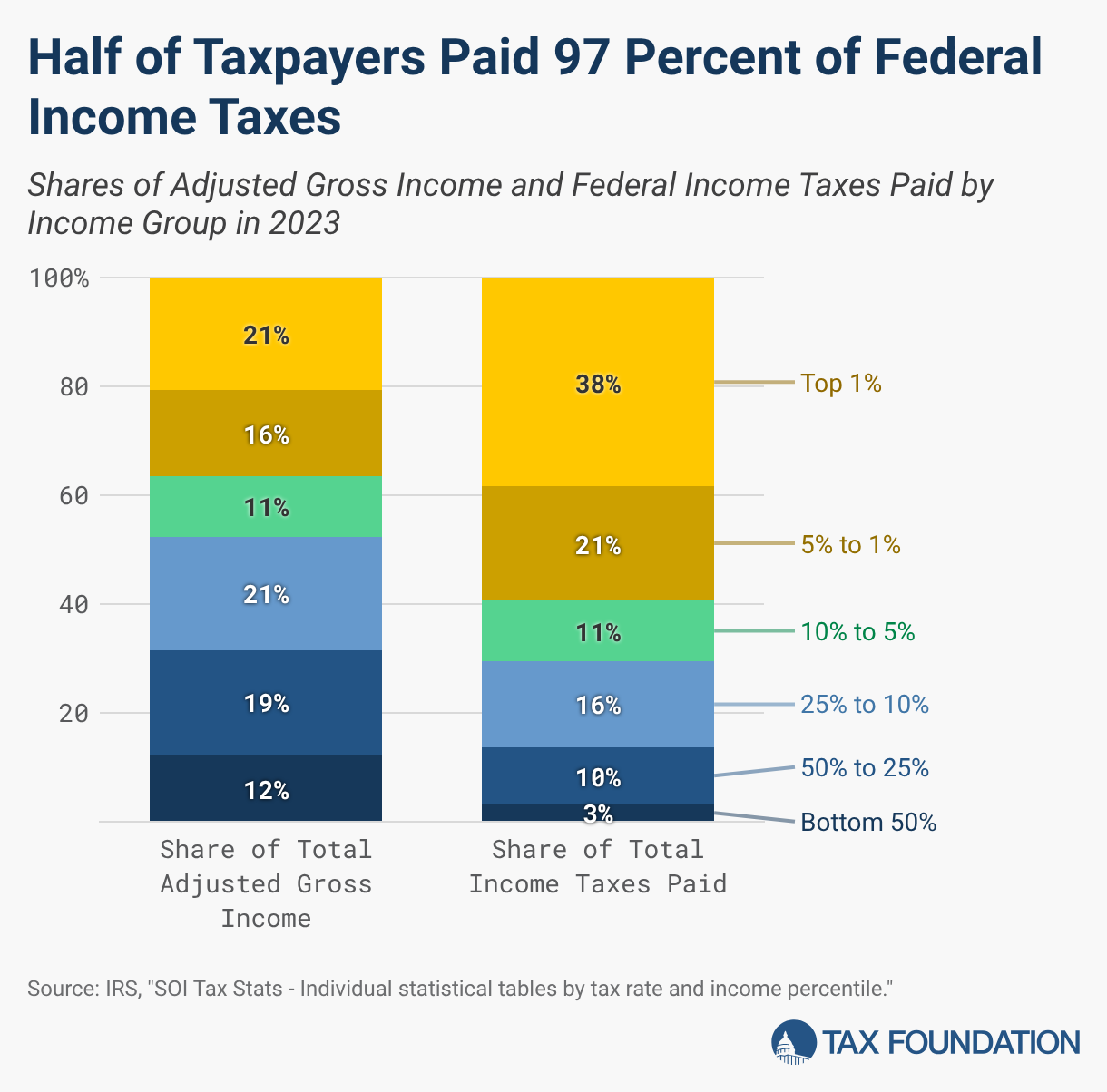
Despite the data depicted above, politicians, writers, etc. get a lot of mileage out of castigating the rich. (They also frequently mislabel “high income” people as rich. Those are not the same thing though they are correlated. It sounds a lot better to say “tax the rich” than it does to say “tax people with high incomes.”)
And the misleading data frequently used always annoys me. From a recent NYT article:
Fifteen years ago, the world’s billionaires collectively had $4.5 trillion.
By 2024, their wealth had more than tripled to $14.2 trillion.
Now, their combined wealth totals $20.1 trillion – an amount that is equivalent to nearly a fifth of the entire world’s total yearly output.
Comparing stocks to flows is not appropriate. Global personal wealth is estimated at around $471 trillion (source). So, they collectively have a little over four percent. That’s still a lot, obviously, but it’s not the exaggerated implication people get from bad comparisons of wealth (a stock) to GDP (a flow). (Stocks vs. Flows)
But Jack Raines makes a provocative point; for all the opprobrium the top 1% seem to receive, in our quotidian lives we are perhaps more negatively impacted by the bottom 1% than we are the top 1%. An excerpt from #26 of his list of 29 reflections:
I’m a firm believer that the bottom decile of society reduces the median citizen’s quality of life exponentially more than whatever acts of “exploitation” billionaires have subjected me to. Most rules, norms, and laws that inconvenience or hinder your day-to-day life are consequences of the actions of the bottom 10% (or even bottom 1%), not the top 1%.
1% of the population is responsible for 63% of all violent crime convictions. A few shoplifting incidents are the reason I have to ring a buzzer at CVS to get toothpaste. This applies to all sorts of anti-social behavior, from violence on the subway to open-air drug usage in downtown San Francisco. Too much ink is spilled on redistributing the wealth of the winners; not enough on containing the damage of the losers.
Eighteenth, from Six lessons from history’s greatest financial crises (or here):
- Safe assets are often the most dangerous
- Bubbles can be positive
- Leverage is deadly
- Complexity is dangerous
- There’s very little new under the sun
- The seeds of the next crisis are often sown in the response to the last
Nineteenth, what do advisors really do? Carry others’ financial anxiety. (That’s at least a significant piece of what a good advisor does.)
Twentieth, does employment slow cognitive decline? “Our evidence … provides further support to the notion that working to older ages may delay age-related cognitive decline.” (source)
Twenty-First, I saw this chart crime:
And not only is it compressed horizontally (exaggerating the slope), the origin is omitted, and it’s in nominal dollars. Here is a better graph in real terms:
Still interesting data, even if less extreme-looking. I’m tempted to say housing looks like it has reached a permanently high plateau, but the last guy who made an observation like that is infamous for it!
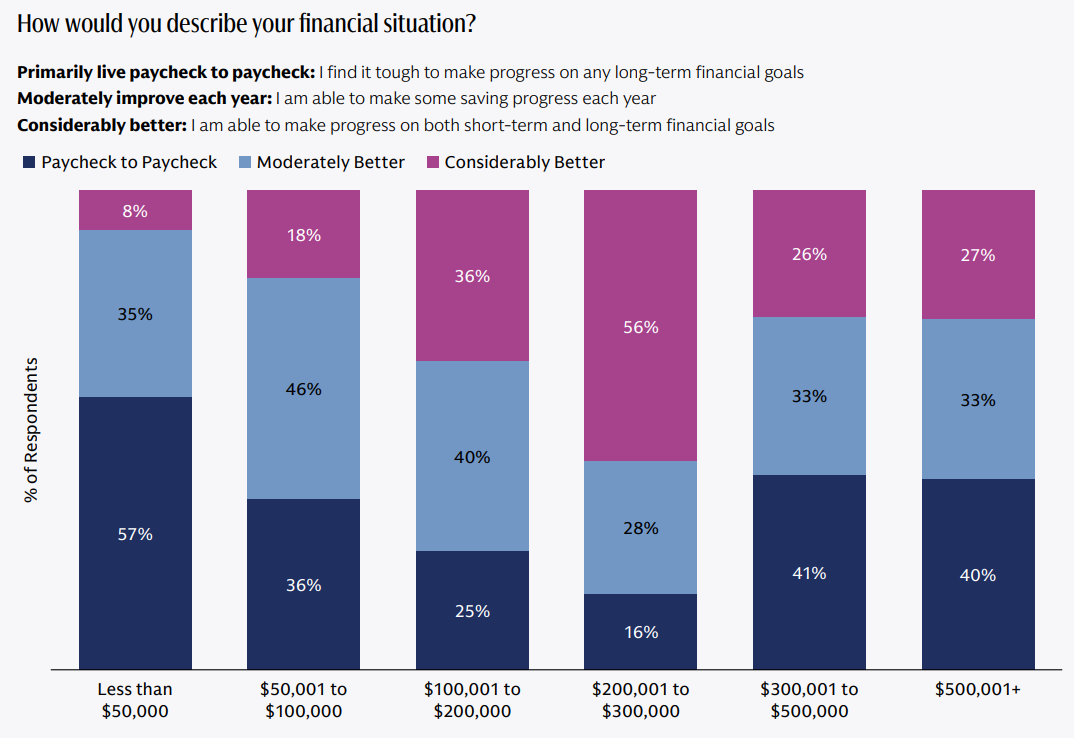
Twenty-Second, paycheck-to-paycheck on a $500k/year? From Goldman Sachs New Economics of Retirement:
40% of people with incomes over $500k/year (and $300k/year) report living paycheck-to-paycheck (unable to make progress on their savings or financial goals). Inexplicably, they’re worse than folks who make $100k to $300k. I can only assume they believe the money train will never end.
As I’ve written (I’m sure) ad nauseum, most financial problems aren’t financial – they’re behavioral. Though I’m not sure I trust this data. I wonder how many of the survey respondents didn’t really read or think about the other options rigorously, because they feel like they are paycheck to paycheck even though they are contributing to their retirement plans, etc. – maybe you get essentially an emotional, rather than factual, answer if done quickly?
On the other hand (source):
A new Wall Street Journal poll finds that even those who consider themselves among the wealthiest classes in America carry high levels of concern about their current finances, the years ahead and the prospects for their children.
More than 40% of Americans who call themselves upper class or upper-middle class say they haven’t saved enough money to retire comfortably. Only about 40% say their financial security is where they thought it would be at this point in their lives. Nearly three in five say they are strained by high gasoline prices.
Those in the wealthiest classes have lost faith that an economy that has benefited them can lift future generations. Some 86% of people who call themselves upper class or upper-middle class say they lack confidence that life for their children will be better than theirs has been. That’s up from 64% in a 2019 survey and shows a level of pessimism that matches the views of less-fortunate groups.
Twenty-Third, nothing new here, but a very comprehensive review of the issue: Private Equity for All: The Paradoxical Push to Democratize Private Markets
Twenty-Fourth, on preparing his taxes: “This is too difficult for a mathematician. It takes a philosopher.” – Albert Einstein
Twenty-Fifth, I read Range a few years ago; this is a good summary. This is similar to the concept of T-Shaped people being the high performers – get broad then get deep.
Twenty-Sixth, I’ve often said that active management is faith-based while passive systematic management (see item 16 above) is evidence-based. A recent paper tries (not entirely successfully in my view) to push that view pretty far:
“[W]e can think of active fund management as a religious group in the sense that it has a unified system of beliefs and practices and constitutes a single moral community centred around the sacred objective of generating ‘alpha’ (above market returns). This pursuit of alpha is deemed sacred here because it has always been built more around belief than logic. Indeed, one could consider alpha as based on supernatural assumptions associated with the promise of future rewards, which corresponds quite exactly to [a] definition of a religion.” [Citations omitted]
Lol.
Twenty-Seventh, this piece on time perception is a little interesting: Language, Time, and the Beauty of Nonlinear Thinking. The portion at the end is just thinking about the future as a MCS essentially, which we’ve all been doing for decades – it isn’t a novel idea!
Twenty-Eighth, some perspective (source):
- Have you taken a flight recently? The majority of Americans did not take one flight in the past year.
- Did you read more than two books last year? You’re in the minority.
- Have a college degree? Also a minority.
- Do you eat out? The most common place that Americans eat out is McDonald’s, and the most popular sit-down restaurant brand is Olive Garden. Is that where you go? Or do you go somewhere fancy, like, you know, TGI Friday’s? What—fancier than that? Wow.
- Are you a white male? Seven in ten Americans are not.
…
I submit to you that the one characteristic that unites the lives of all Normal People is this: They are at the mercy of forces greater than themselves. They have to work for money in order to pay bills in order to survive. They are at all times subject to the cruel depredations of fate. Even if they have savings, the stability of their lives could be snatched away by a single disaster. If they rest for too long, they will lose their ability to support themselves and their families. They are all, to varying degrees, in the position of having to do things that they would not choose to do, because those things are necessary in order to earn money and live and navigate their position in society.
And guess what? Once you have a few million dollars in the bank, you are no longer in the position that I describe. Once you have a few million dollars in the bank, you may still choose to work, and you may still want to get richer, and you may decide to live a more lavish lifestyle that requires more income, but you are fundamentally removed from the necessity of shaping your life around the need to work to live a decent life. A few million bucks in the bank means that you have passed from the world of need to the world of choice. You have gained the ability to dictate the substance of your life. You have finished weaving the safety net that will prevent you from falling into the pit of penury. You may still like the same things that other people like, but you do not share the most powerful defining feature of their lives. You are free in a way that they are not and never will be.
This does not make you a bad person. This does not mean you don’t deserve to be happy. That doesn’t mean that you have no problems. I am not sitting here telling you to feel guilty. I am simply stating the material fact that at a certain level of wealth, it becomes impossible to be truly in touch with the life experience of most people, because the most significant aspect of that life experience is one that disappears when you surpass a certain level of wealth. If you do not have to work to live then, yes, you are out of touch with the organizing principle of the average person’s life. You may feel sympathy for them, or spiritual and political affinity, but your life is of a fundamentally different type than theirs.
Congratulations! You’re out of touch. Enjoy it. If you don’t like it, give all of your money away. Otherwise, shut … up.
And some global perspective, From page 35:
The United States had the highest returns of any country during the twentieth century, returning 7.57% per annum. Australia returned 7.00% and the Netherlands 6.32%. The lowest returns came from Austria (0.32%) and Italy (1.24%). The average return excluding the United States was 4.87%. There was a wide dispersion of returns to individual countries because national experiences in the twentieth century were so different as a perusal of the returns reveals.
You get similar results if you go from 1900 to 2025. Since returns between 2000 and 2025 have so far been lower in most countries than during the twentieth century, the annual averages declined, but the rankings remain similar. The United States (7.08%) has had the highest annual returns since 1900 with Australia (6.64%) in second place. Austria (1.03%) and Italy (1.50%) remain the only two countries with returns under 2% during the past 125 years. The average return excluding the United States is now 4.45%. Nine of the twenty-five countries provided average returns over 5% between 1900 and 2025.
(NB, those figures are real, not nominal.)
From page 318:
The United States has represented over half of global stock market capitalization during most of the past century. The United States was able to avoid the destruction of World Wars I and II and the nationalizations that occurred after World War II. Anglo countries have always had more of a market orientation than continental Europe and this is reflected in the differences in the returns to the World index and the World x/USA index. The United States has consistently outperformed the rest of the world. The United States has been the engine of economic growth since the American Civil War ended. There have been periods, such as the 1950s and 1980s when the World x/USA outperformed the United States, but these periods have been the exceptions rather than the rule. Today, Europe and Japan face declining populations, low growth in GDP, low bond yields and governments that often represent half of GDP. Europe has not been able to take the lead on the internet and information technology during the current century. In technology, China and other Asian countries have been more successful than Europe. The World x/USA did outperform the United States in 2025. Whether it can continue to do so in the rest of the decade remains to be seen.
Twenty-Ninth, Ben Carlson makes some excellent points here. I think they’re excellent, of course, because I’ve made the same ones for a long time. I quoted the same Bernstein passage in Ruminations by Other People and I recommended many of the same authors he lists in Ruminations on Being a Financial Professional. I also made these points:
- It almost certainly isn’t different this time.
- Study market history. In particular, read contemporaneous accounts of different periods. As Mark Twain is reputed to have said, “History doesn’t repeat itself, but it rhymes.” As Santayana did say, “Those who cannot remember the past are condemned to repeat it.” And finally, another quote from Mark Twain, “The man who does not read good books has no advantage over the man who can’t read them.”
- History is a great guide to what can happen (how bad it can get) but a terrible guide to what will happen.
- The worst-case scenario in history, was not the worst case just prior to it occurring.
Thirtieth, contrary to popular belief, giving people money doesn’t help because (as I keep saying repeatedly) most issues are behavioral. There is an excellent literature review here. I think you are going to hear even more in the future about UBI. Higher income and wealth are correlated with all sorts of positive things, but they don’t cause the positive things.
TL;DR: “Sending money to those in need increases their consumption and leisure, … [but] giving people more resources won’t solve all the other problems associated with poverty, at least in the developed world.”
(See also this.)
Thirty-First, wealth tax math here from the always excellent Paul Graham.
Also, are FICA taxes, taxes? Excellent point here. (Answer, not on lower-income folks, but yes on higher-income folks.)
Thirty-Second, you may have seen this (front page!) article in the WSJ recently. While the headline got softened for the online version at the link, the headline in the print edition read: “Risk Premium for Holding Stocks Over Bonds Vanishes”
I don’t like the metric they use (even though it’s the conventional one). The earnings yield is (you would assume) real while the 10-year Treasury is nominal. It’s apples and oranges.
I pulled the data from here and here and while the ERP is very low, it’s not zero. I wish I had data going back further on the TIPS yield, but it might not be that useful – when TIPS were new I think they had high yields just because people weren’t comfortable with them yet and they weren’t in high demand.
Incidentally, if you graph the data from those sources, and also subtract the TIPs yield from the earnings yield to get a ERP line, that dip in the ERP during the GFC is why you want to use something like the CAPE. Earnings were terrible, but that wasn’t a good estimate of what they were expected to be in the future. Also, don’t be mislead by the Earnings Yield and ERP lines looking so similar for a while, that’s just an artifact of TIPS rates being zero-ish.
However, the larger point of the WSJ article sort of holds. Large U.S. stocks are richly priced compared to bonds.
Thirty-Third, why do smart people make bad investment decisions? Some answers here.
Thirty-Fourth, is AI a bubble? See Michael Mauboussin here and here on Bayes and Base Rates.
Thirty-Fifth, “[O]ne of the cushiest white-collar jobs” – that would be ours!
Once they survive the industry’s early gauntlet—the cold calls, networking events, referral-chasing and years of trying to persuade strangers to hand over their savings—wealth advisers can earn upwards of $500,000 a year, or many times that for partners and firm founders. Clients may be hard to win, but they’re slow to leave and as their assets grow, so do the earnings off fees. The vast majority of advisers report on industry surveys being “highly fulfilled with their career.”
It’s from an article (or here) about AI coming for wealth management. But: “For now, mini-millionaires ($1 million to $5 million of liquid assets) and the very-high-net-worth crowd ($5 million to $30 million) still want humans to hold their hands.”
Thirty-Sixth, the origin of “average” (in the mathematical sense) is fascinating. (If you like this sort of thing, I highly recommend Peter Bernstein’s Against the Gods.)
Thirty-Seventh, the piece, 7 Ideas That Should Make You Distrust Your Own Mind is great. The application to markets and financial planning is left as an exercise for the reader.
Thirty-Eighth,
Thirty-Ninth, I mostly stay away from politics here, but I recently read Profiles in Courage (JFK, 1956) and I ran across this, quoted from John Quincy Adams (John Adam’s son) diary entry shortly after joining the U.S. Senate in 1803:
The country is so totally given up to the spirit of party, that not to follow the one or the other is an unexpiable offence. The worst of these has the popular current in its favor, and uses its triumph with all the unprincipled fury of faction; while the other is waiting, with all the impatience of revenge, for the time when its turn may come to oppress and punish by the popular favor.
1803!
Also (not from the book):
“There is So much Rascality, so much Venality and Corruption, so much Avarice and Ambition, such a Rage for Profit and Commerce among all Ranks and Degrees of Men even in America, that I sometimes doubt whether there is public Virtue enough to support a Republic.” – John Adams, 1776
“The alternate domination of one faction over another, sharpened by the spirit of revenge, natural to party dissention, which in different ages and countries has perpetrated the most horrid enormities, is itself a frightful despotism. But this leads at length to a more formal and permanent despotism. The disorders and miseries, which result, gradually incline the minds of men to seek security and repose in the absolute power of an individual: and sooner or later the chief of some prevailing faction, more able or more fortunate than his competitors, turns this disposition to the purposes of his own elevation, on the ruins of Public Liberty.” – George Washington, 1796
“Oh my country, how I mourn over thy follies and Vices, thine ignorance and imbecility, Thy contempt of Wisdom and Virtue and overweening Admiration of fools and Knaves!” – John Adams, 1806
See also here and here.
Plus ça change, plus c’est la même chose!
Fortieth, there is an elementary recap of arithmetic vs. geometric returns and the value of diversification here which included a nice pithy summary of how to invest: “Maximize diversification and discipline; minimize expenses and emotions.”
Forty-First, I looked at SPY (which is an S&P 500 index fund) history on Yahoo Finance (adjusted close, which assumes dividend reinvestment). The low was $49.68 on 3/9/2009. The close last Friday (7/10/2026) was $754.95. That is 17.336 years. (754.95/49.68)^(1/17.336)-1=16.99% CAGR. We’ve had 17+ years of 17% returns.
But, of course, none of us (or our clients) got that because we (wisely!) diversified. <<Sad Trombone>>
$100,000 invested with perfect foresight in SPY on 3/9/2009, with dividends reinvested (and no tax drag), would be worth more than $1.5 million today ($100,000*754.95/49.68).
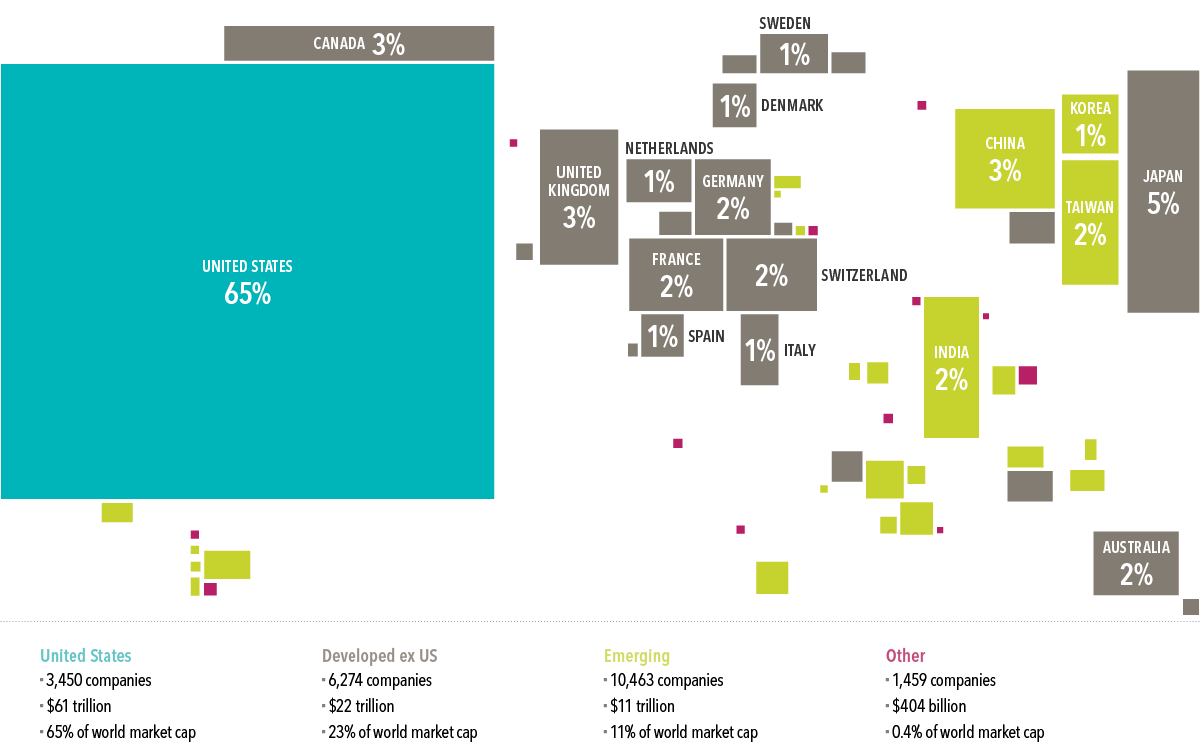
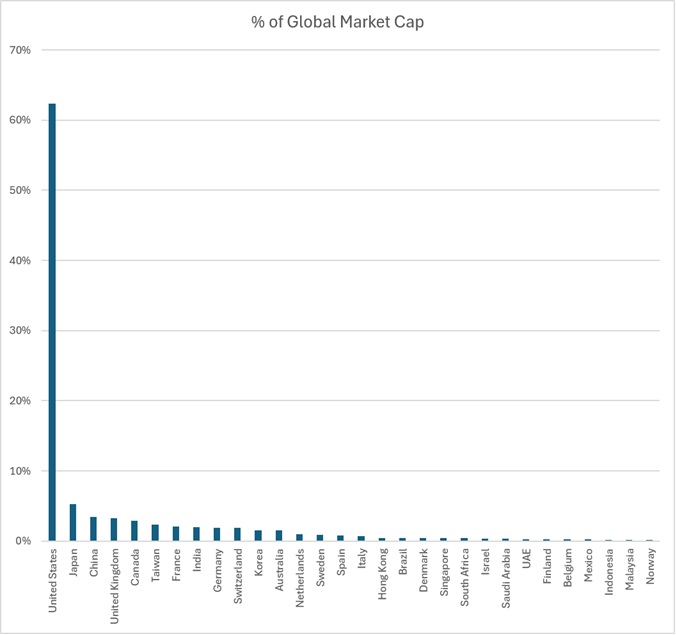
Forty-Second, we all know (I think) that the U.S. is approximately 60% of the global market cap (actual number, 62.3%). But to see it visually (source) and note that #2 is Japan at 5.3% is astounding.
I thought a bar chart would be an even better visual, so I made one. (This is only the top 30 countries because the other 55 countries are under 0.20% and don’t even show on the graph. Collectively they are 1.7%.)
Forty-Third, signs of a top? Stories here.
I have my own story. My waiter at Ellen’s in either 1998 or early 1999 (based on when I was in NYC) saw me reading the WSJ and wanted to talk stocks: He had $100k and wanted to know if he should “put it on” CSCO or AOL (note the wording there).
I chatted with him (suggesting 90% in an index fund and maybe 10% for speculation), went back to reading, then almost did a spit take when I remembered the Joe Kennedy story and realized the waiter was in.
The plural of anecdote is not data, but I do think the stories in that article capture the zeitgeist and the current SPCX and AI hype have me a little worried. It is very hard (I’d say impossible) to get the timing right though. I think the waiter story probably happened in 1998, and two years of missing a ripping bull market is a long time. I was in the industry, but not client-facing, so I didn’t have to make any allocation decisions at the time (other than my tiny amount of money).
From the BIS:
Historical episodes of investment booms offer instructive parallels ... The canal mania of the 1830s, the British railway mania in the 1840s, the electrification exuberance of the late 1920s (roaring 20s) and the dotcom boom of the late 90s all shared one common trait: a genuine technological breakthrough that attracted capital in excess of what commercial returns could ultimately justify. These episodes ended with an eventual reversal in investment, inducing economy-wide recessions. The scale and pace of the current AI investment boom accompanied by expectations of large productivity payoffs bear resemblance to these precedents, highlighting potential downside risks in the near term.
As I wrote six months ago: “This is starting to feel like the internet fiber build-out in the 1990s or the railway network build-out in the 19th century. Neither of those ended well for investors.”
And a year before that, I expounded on: “It almost certainly isn’t different this time.” (See also here.)
In 2018, I wrote:
To profit from new technology is harder than first appears. There are two ways to profit:
First, you can recognize the technology revolution – but if everyone recognizes it, then all the investment opportunities are already at least fully valued, if not overvalued (people tend to get carried away). So you must recognize a new technology has enormous potential while others don’t see it. That is difficult to say the least.
Second, you can figure out which company is going to be the winner in the gold rush. Again, you must be better at predicting than everyone else. Another extremely difficult challenge.
History is replete with life-changing technologies, but in virtually every case, investors (in aggregate) lost money trying to pick the winners (though of course a lucky few made fortunes). Examples include the railway mania of the 19th century, the automobile industry in the early 20th century, the PC revolution in the early 1980’s, the dot-com and internet boom of the late 1990’s, etc.
Railroads and cars might not seem like cutting-edge technology like blockchain, but they certainly were at the time.
As Wikipedia notes, “There were over 1,800 automobile manufacturers in the United States from 1894 to 1930. Very few survived.” Even Henry Ford’s first attempt failed.
See also this.
Forty-Fourth, some much-needed clarity from Cliff Asness (and co-authors) on affordability here.
Forty-Fifth, the most recent Investments & Wealth Review (here) had excellent articles reviewing some more advanced planning techniques. I have strongly encouraged our associates to read the first three articles (and peruse the rest of the issue for whatever catches their attention). Those three articles are:
- The Art Before the Deal (dynasty trust techniques, QSBS strategies, DAFs, CRTs, CLTs)
- Listening to the Next Generation (1031s and 721s aka UPREITs)
- Beyond the Portfolio (CRTs, CLTs, CGAs)
Additional articles you also may be interested in are on PPLI (pages 32 & 36) and geographic diversification (of lives, not portfolios, pages 22 & 25).
All of that is a good review of things that were either barely on the CFP exam or not on there at all, but which we should be aware of as we work with HNW clients.
Finally, my recurring reminder that J.P. Morgan’s updated Guide to the Markets for this quarter is out and filled with great data as usual.
That’s it for this quarter. I hope some of the above was beneficial.
If you are receiving this email directly from me, you are on my list of Financial Professionals who have requested I share things that may be of interest. If you no longer wish to be on this list or have an associate who would like to be on the list, simply let me know.
We have clients nationwide; if you ever have an opportunity to send a potential client our way that would be greatly appreciated. We also have been hired by some of our fellow advisors as consultants to help where we can with their businesses. If you are interested in learning more about that arrangement, please let us know.
We also offer a monthly email newsletter, Financial Foundations, which is intended more for private clients. If you would like to be on that list as well, you may edit your preferences here.
Finally, if you have a colleague who would like to subscribe to this list, they may do so from that link as well.
Regards,
David
Disclosure
|